

The Career Curve - July Edition

In this edition:
This month, the quiet cost of holding position in a market that will not let you move.
Register for a FREE webinar on burnout. From boardroom to bedroom
Author: Justin Naidoo, SPCC | 4 min read
As I laced up my skates readying myself for hockey practice last week, I was already drained. Not from tying knots but from the workload earlier in the day. I ran the drills, blew the whistle, gave the kids the same energy I always try to give them. From the stands, I looked like a coach who had it together. Inside, I had nothing left, and I noticed it. I drove home and sat in the driveway for a few minutes before I could go inside.
I think a lot of you are doing the same thing. Just at a bigger scale, and with higher stakes.
A good headline is the easiest place to hide.
Canada added around 88,000 jobs in May and unemployment fell to 6.6%. Read quickly, that sounds like recovery. Read closely, it is quieter than that. A large share of the gain was part-time, and the labour force keeps thinning as people step back from the search entirely. South of the border the same pattern is sharper. The U.S. unemployment rate improved mostly because roughly 720,000 people stopped looking, and participation fell to its lowest point since 2021.
This is what a selective market looks like. And choosy markets do something specific to the people inside them. They make you stay.
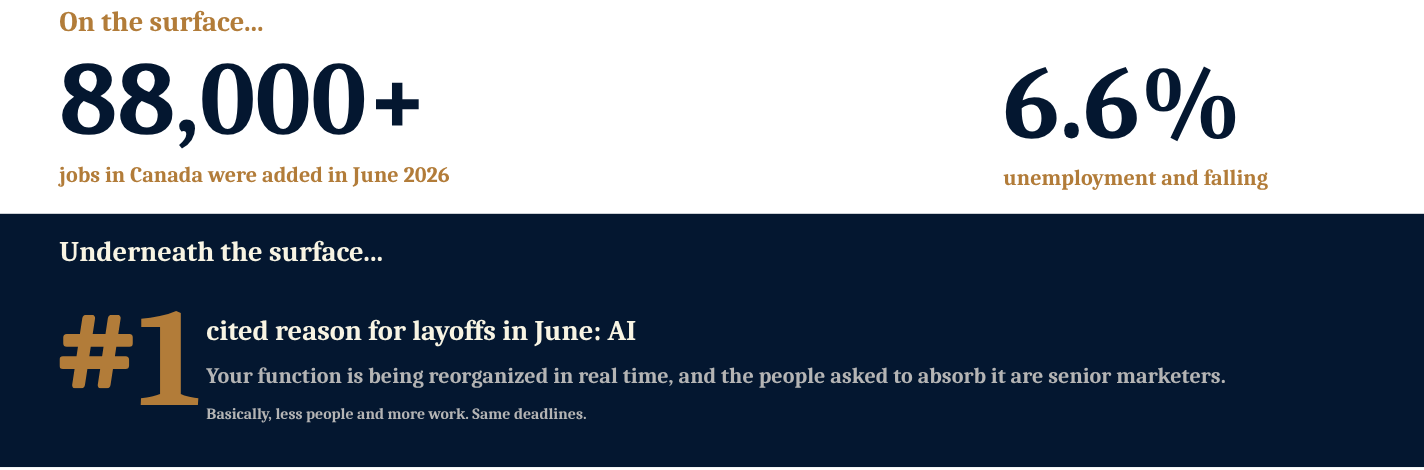
The data is showing us the work that was left behind from a laid off colleague was redistributed, and a good portion landed on you. Despite being told AI would close the gap. Some of it does. Most of it still needs your judgment, your context, your relationships. So you’re naturally carrying more, with less, in a market where walking away feels riskier than staying.
That is the burnout of this moment. No dramatics. It hides behind competence. It shows up in three places.
Strength: Your body keeps the score first. The skipped workouts, the seven-o'clock dinners eaten at nine, the sleep you trade for one more deck. Leaders are the last to admit the tank is empty, because admitting it feels like weakness, but it’s not. That’s the data. Listen to your body. It usually sends the warning signals far before you decide to override it.
Mind: The skills holding their value in this market are the human ones. Judgment. Adaptability. Reading the room. Resilience. The things AI cannot flatten. Every one of them runs on a clear mind. A depleted mind makes worse calls, misreads people, and mistakes motion for progress. You cannot out-hustle a market like this. You have to out-think it, and thinking requires rest you are probably not taking.
Spirit: This is the one we skip. When the work stops connecting to anything larger than the metric, the fatigue turns into something heavier. A quiet question starts running underneath. What is this all for? I do not have a tidy answer for you. I know that ignoring the question does not make it go away. It just gets louder in the driveway at the end of the day.
Run a mid-year audit…on yourself
Where is your energy actually going, and what is it the ROI. Get honest about which of the three is running lowest, strength, mind, or spirit, and give that one something real this month. A true day off. A conversation with someone who you trust. A boundary you have meant to set for a year.
The leaders who come through successfully on the other side of burnout are the ones who noticed the cost early and did something while they still had a choice.
Stay tuned for news on a webinar that I’ll be co-hosting specifically on the topic of burn out…at the office and at home.